Has Jesus Already Spoken?
When Conviction Meets Sin

We live in a world that tells us to follow our truth. Jesus calls us to follow Him.
Before I call something my conviction, my freedom, or my truth, there is a harder question I need to ask:
Has Jesus already spoken?
Before I call something my conviction, my freedom, or my truth, there is a harder question I need to ask:
Has Jesus already spoken?
A reflection on sin, surrender, and what it really means to say, “Jesus is Lord.”
We Need to Talk About Sin
This week at our Midweek Service, our conversation about Christian convictions took us somewhere I believe we needed to go.
We’ve talked about essentials, important matters, and personal convictions, including areas where faithful Christians may reach different conclusions.
But before we go any further into personal convictions, there is another word Christians cannot afford to avoid:
We’ve talked about essentials, important matters, and personal convictions, including areas where faithful Christians may reach different conclusions.
But before we go any further into personal convictions, there is another word Christians cannot afford to avoid:
Sin.
What is sin according to the Bible?
Sin is more than making a mistake or breaking a religious rule. At its heart, sin is rejecting God’s way and choosing our own.
Sometimes we soften it with other words. We call it a mistake, a struggle, brokenness, my truth, or simply a personal choice.
Those words may describe part of our experience, but they cannot replace what Scripture calls sin.
And sin is never harmless.
It damages our relationship with God. It wounds people. It breaks trust. It can tear apart marriages and families, divide friendships, damage churches, compromise leadership, and leave consequences that last far beyond the original decision.
That is why Christians should not be afraid to talk about sin.
We don't talk about sin because we want to condemn people. We talk about sin because sin destroys people Jesus loves.
Sin is more than making a mistake or breaking a religious rule. At its heart, sin is rejecting God’s way and choosing our own.
Sometimes we soften it with other words. We call it a mistake, a struggle, brokenness, my truth, or simply a personal choice.
Those words may describe part of our experience, but they cannot replace what Scripture calls sin.
And sin is never harmless.
It damages our relationship with God. It wounds people. It breaks trust. It can tear apart marriages and families, divide friendships, damage churches, compromise leadership, and leave consequences that last far beyond the original decision.
That is why Christians should not be afraid to talk about sin.
We don't talk about sin because we want to condemn people. We talk about sin because sin destroys people Jesus loves.
“Why do you call me, ‘Lord, Lord,’ and do not do what I say?”
Luke 6:46
Luke 6:46
If Jesus is Lord, what happens when He tells me I’m wrong?
Calling Jesus Lord means more than believing the right things about Him. It means recognizing His authority over all of me, including the parts of my life I would rather keep for myself.
Jesus is not only Lord when His Word comforts me. He is still Lord when His Word confronts me.
Jesus is not only Lord when His Word comforts me. He is still Lord when His Word confronts me.
I Know What It's Like to Stop Listening

There was a season in my life when I was convinced I was right.
I had my reasons. I had my perspective. I could explain why I was making the decisions I was making. And the more convinced I became that I was right, the harder it became for me to hear anyone who challenged me.
The painful part is that some of the people challenging me were people who genuinely loved me.
They warned me.
They tried to reason with me.
They could see things happening in my life that I either couldn't see yet or simply didn't want to see.
But instead of hearing their concern as love, I began hearing it as judgment.
Instead of asking, “Could they be seeing something I’m missing?” pride caused me to think, “They just don’t understand me.”
And eventually, I began pushing away some of the very people who were trying to pull me back toward Jesus.
I had my reasons. I had my perspective. I could explain why I was making the decisions I was making. And the more convinced I became that I was right, the harder it became for me to hear anyone who challenged me.
The painful part is that some of the people challenging me were people who genuinely loved me.
They warned me.
They tried to reason with me.
They could see things happening in my life that I either couldn't see yet or simply didn't want to see.
But instead of hearing their concern as love, I began hearing it as judgment.
Instead of asking, “Could they be seeing something I’m missing?” pride caused me to think, “They just don’t understand me.”
And eventually, I began pushing away some of the very people who were trying to pull me back toward Jesus.
Pride has a way of doing that.
“The way of fools seems right to them, but the wise listen to advice.”
Proverbs 12:15
Proverbs 12:15
Looking back, I can see how accurately that described me.
I took a job that placed me in an environment where compromise became easier. But I want to be careful about how I say that because the job wasn't ultimately the problem. My heart was.
I began drinking. Partying. Becoming increasingly comfortable with things that were pulling me away from the life I had committed to Jesus.
And at the same time, I began pulling away from the body of Christ.
The dangerous thing is that I didn't wake up one morning and announce:
“I'm walking away from God.”
It was much quieter than that.
One compromise.
One excuse.
One person I stopped listening to.
One gathering I decided wasn't that important.
One boundary moved.
One decision justified.
And then another.
I took a job that placed me in an environment where compromise became easier. But I want to be careful about how I say that because the job wasn't ultimately the problem. My heart was.
I began drinking. Partying. Becoming increasingly comfortable with things that were pulling me away from the life I had committed to Jesus.
And at the same time, I began pulling away from the body of Christ.
The dangerous thing is that I didn't wake up one morning and announce:
“I'm walking away from God.”
It was much quieter than that.
One compromise.
One excuse.
One person I stopped listening to.
One gathering I decided wasn't that important.
One boundary moved.
One decision justified.
And then another.
I drifted.
Eventually, I fell hard.
And when I look back now, one of the hardest realizations is that some of the people I thought were against me were actually fighting for me.
They cared about my relationship with God.
They cared about my soul.
They saw where the road could lead before I was willing to admit where I was going.
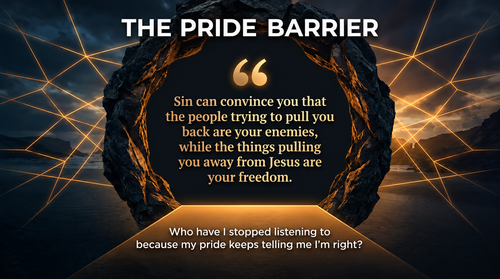
That's why this statement from our Midweek conversation is so personal to me:
And when I look back now, one of the hardest realizations is that some of the people I thought were against me were actually fighting for me.
They cared about my relationship with God.
They cared about my soul.
They saw where the road could lead before I was willing to admit where I was going.
That's why this statement from our Midweek conversation is so personal to me:
I've lived that.
And perhaps someone reading this has too.
Maybe somebody who loves you has been asking questions you don't want to answer.
Maybe you've become defensive whenever a certain subject comes up.
Maybe you've started distancing yourself from people who challenge you and surrounding yourself only with people who affirm you.
Maybe the issue isn't that everyone around you is judging you.
Maybe God, in His mercy, has put people in your life who love you enough to tell you the truth.
So here's a question I wish I had been humble enough to ask sooner:
And perhaps someone reading this has too.
Maybe somebody who loves you has been asking questions you don't want to answer.
Maybe you've become defensive whenever a certain subject comes up.
Maybe you've started distancing yourself from people who challenge you and surrounding yourself only with people who affirm you.
Maybe the issue isn't that everyone around you is judging you.
Maybe God, in His mercy, has put people in your life who love you enough to tell you the truth.
So here's a question I wish I had been humble enough to ask sooner:
Who have I stopped listening to because my pride keeps telling me I’m right?
Sin Has a Direction
One of the things I’ve learned is that sin rarely takes us somewhere all at once.
It has a direction.
James describes the progression:
It has a direction.
James describes the progression:
“Each person is tempted when they are dragged away by their own evil desire and enticed. Then, after desire has conceived, it gives birth to sin; and sin, when it is full-grown, gives birth to death.”
James 1:14–15
James 1:14–15
James shows us a progression:
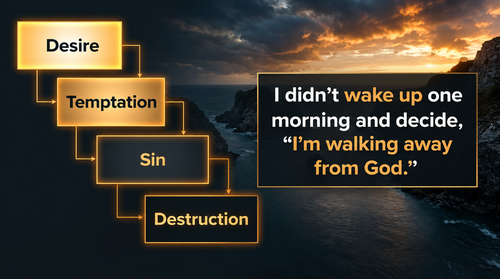
The frightening thing is that when we’re standing at the beginning of that progression, we usually aren’t thinking about where it could eventually lead.
Nobody plans the last step while standing at the first one.
That’s why Scripture also warns us about something much quieter: drift.
Nobody plans the last step while standing at the first one.
That’s why Scripture also warns us about something much quieter: drift.
“We must pay the most careful attention, therefore, to what we have heard, so that we do not drift away.”
Hebrews 2:1
Hebrews 2:1
Drifting is dangerous because it doesn’t always feel like rebellion.
Sometimes it looks like praying a little less.
Opening Scripture a little less.
Pulling away from Christian community.
Becoming defensive when someone challenges us.
Hiding something we once would have confessed.
Moving a boundary we once believed was important.
Explaining away something that used to trouble our conscience.
And little by little, what once felt uncomfortable begins to feel normal.
Sometimes it looks like praying a little less.
Opening Scripture a little less.
Pulling away from Christian community.
Becoming defensive when someone challenges us.
Hiding something we once would have confessed.
Moving a boundary we once believed was important.
Explaining away something that used to trouble our conscience.
And little by little, what once felt uncomfortable begins to feel normal.
That’s the danger of drift.
The question is not simply:
“Is this one decision going to destroy my life?”
A better question might be:
“Is this one decision going to destroy my life?”
A better question might be:
“Where is this decision taking me?”
Because every decision has a direction.
Is this moving me toward Jesus, or is it slowly teaching my heart how to live without Him?
Is this moving me toward Jesus, or is it slowly teaching my heart how to live without Him?
Forty Years Later
This year marks 40 years since my baptism into Christ.
Forty years.
I can still think back to that young man in Lexington, Massachusetts, who made the decision to surrender his life to Jesus, confess Him as Lord, and be baptized into Christ.
I understood that I wanted to follow Jesus.
What I could not have understood then was everything that following Him would involve.
There would be victories and failures. Seasons of tremendous faith and seasons when I struggled. Times when I listened and times when I was stubborn. Moments when I followed closely and, as I’ve already shared, times when I drifted.
But through all of it, one thing has remained true:
Forty years.
I can still think back to that young man in Lexington, Massachusetts, who made the decision to surrender his life to Jesus, confess Him as Lord, and be baptized into Christ.
I understood that I wanted to follow Jesus.
What I could not have understood then was everything that following Him would involve.
There would be victories and failures. Seasons of tremendous faith and seasons when I struggled. Times when I listened and times when I was stubborn. Moments when I followed closely and, as I’ve already shared, times when I drifted.
But through all of it, one thing has remained true:
Jesus has been faithful.
Forty years has taught me something about the words “Jesus is Lord.”
They aren't simply words I confessed at the beginning of my Christian life.
They are words I am still learning to live.
Lordship means that when Jesus comforts me, He is Lord.
When Jesus corrects me, He is Lord.
When His Word agrees with what I want, He is Lord.
When His Word confronts what I want, He is still Lord.
And when I have failed Him, His grace has never meant pretending my sin wasn't sin.
Grace has meant that Jesus tells me the truth about my sin and still calls me home.
Then I’d introduce a short Scripture:
They aren't simply words I confessed at the beginning of my Christian life.
They are words I am still learning to live.
Lordship means that when Jesus comforts me, He is Lord.
When Jesus corrects me, He is Lord.
When His Word agrees with what I want, He is Lord.
When His Word confronts what I want, He is still Lord.
And when I have failed Him, His grace has never meant pretending my sin wasn't sin.
Grace has meant that Jesus tells me the truth about my sin and still calls me home.
Then I’d introduce a short Scripture:
“But God demonstrates his own love for us in this: While we were still sinners, Christ died for us.” Romans 5:8
My forty-year testimony isn't, “Look how faithfully I've followed Jesus.”
It's, “Look how faithfully Jesus has pursued me.”
That is the hope of the gospel.
Sin is serious because it separates us from the God who created us and leads us places we were never meant to go.
But Jesus did not come merely to point out our sin.
He came to save us from it.
The cross tells me that my sin is more serious than I sometimes want to admit.
But it also tells me that the love and grace of Jesus are greater than I could ever deserve.
So after forty years, I am not celebrating my ability to hold onto Jesus.
Sin is serious because it separates us from the God who created us and leads us places we were never meant to go.
But Jesus did not come merely to point out our sin.
He came to save us from it.
The cross tells me that my sin is more serious than I sometimes want to admit.
But it also tells me that the love and grace of Jesus are greater than I could ever deserve.
So after forty years, I am not celebrating my ability to hold onto Jesus.
I am grateful that Jesus never stopped calling me back to Himself.
So What About My Personal Convictions?
After talking this much about sin, someone might wonder:
Does that mean there is no room for personal conviction?
Not at all.
Scripture shows us that there are matters where faithful Christians can reach different conclusions while sincerely trying to honor God. Romans 14 is a great example. Paul addresses believers who had different convictions about food and special days, yet belonged to the same Lord.
That's important because following Jesus doesn't require us to have identical opinions about every decision.
But here's the distinction we cannot miss:
Does that mean there is no room for personal conviction?
Not at all.
Scripture shows us that there are matters where faithful Christians can reach different conclusions while sincerely trying to honor God. Romans 14 is a great example. Paul addresses believers who had different convictions about food and special days, yet belonged to the same Lord.
That's important because following Jesus doesn't require us to have identical opinions about every decision.
But here's the distinction we cannot miss:
Personal conviction begins where Scripture gives me room.
If God has clearly spoken about something, I don't get to rename disobedience “my personal conviction.”
I can't call something my truth simply because God's truth makes me uncomfortable.
And I can't use Christian freedom as permission to do whatever I want.
Paul actually challenges that way of thinking:
I can't call something my truth simply because God's truth makes me uncomfortable.
And I can't use Christian freedom as permission to do whatever I want.
Paul actually challenges that way of thinking:
“I have the right to do anything,” you say, but not everything is beneficial.
1 Corinthians 10:23
And just a few verses later, he gives us a much better question:
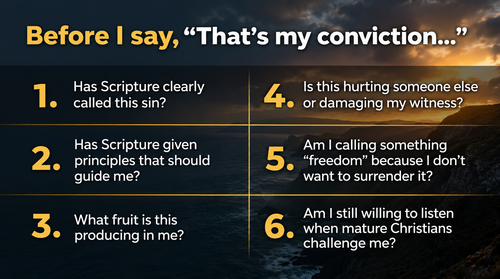
So before I say, “That's just my conviction,” I need to slow down and ask some harder questions.
1 Corinthians 10:23
And just a few verses later, he gives us a much better question:
“So whether you eat or drink or whatever you do, do it all for the glory of God.”
1 Corinthians 10:31
So before I say, “That's just my conviction,” I need to slow down and ask some harder questions.
This is where I would use your six filters, because they're genuinely useful:
Side note:
6. Am I still willing to listen when mature Christians challenge me?
This doesn’t mean mature Christians are the only people we can learn from. A humble disciple stays teachable. God can use anyone, and even difficult situations, to reveal something we need to see. The point is not that every opinion is automatically right, but that I should be humble enough to listen, examine what is being said in light of Scripture, and ask, “Is there something here God wants me to see?”
“To answer before listening—that is folly and shame.”
Proverbs 18:13
Being teachable doesn't mean everyone is right. It means I'm humble enough to listen before deciding they're wrong.
6. Am I still willing to listen when mature Christians challenge me?
This doesn’t mean mature Christians are the only people we can learn from. A humble disciple stays teachable. God can use anyone, and even difficult situations, to reveal something we need to see. The point is not that every opinion is automatically right, but that I should be humble enough to listen, examine what is being said in light of Scripture, and ask, “Is there something here God wants me to see?”
“To answer before listening—that is folly and shame.”
Proverbs 18:13
Being teachable doesn't mean everyone is right. It means I'm humble enough to listen before deciding they're wrong.
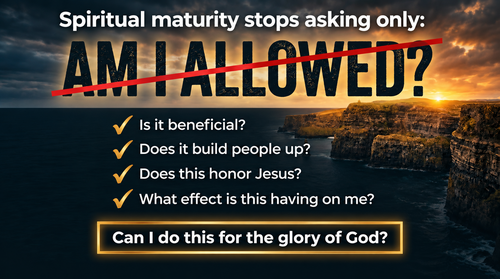
Maturity changes the question.
When we're immature, we tend to ask:
“Am I allowed to do this?”
Or:
“Where exactly is the line?”
But as we mature in Christ, the questions begin to change:
“Am I allowed to do this?”
Or:
“Where exactly is the line?”
But as we mature in Christ, the questions begin to change:
That is a very different way to live.
It moves Christianity away from trying to figure out how close I can get to the line and toward asking:
It moves Christianity away from trying to figure out how close I can get to the line and toward asking:
What decision best honors Jesus?
And that's where personal conviction belongs.
Not as a loophole around the lordship of Jesus.
Not as a way of baptizing whatever I already wanted to do.
But as a sincere attempt to honor Jesus in areas where Scripture gives me room to exercise wisdom, conscience, and faith.
Freedom in Christ isn't freedom from His lordship. It's freedom lived under His lordship.
Not as a loophole around the lordship of Jesus.
Not as a way of baptizing whatever I already wanted to do.
But as a sincere attempt to honor Jesus in areas where Scripture gives me room to exercise wisdom, conscience, and faith.
Freedom in Christ isn't freedom from His lordship. It's freedom lived under His lordship.
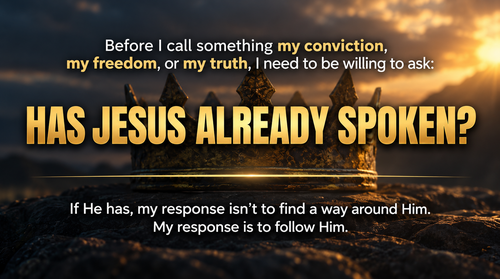
After all of this, maybe the most important question isn't:
“Can I do this?”
Or even:
“Is this my personal conviction?”
Maybe the better question is:
“Can I do this?”
Or even:
“Is this my personal conviction?”
Maybe the better question is:
Has Jesus Already Spoken?
If He has, then my task isn't to find a way around what He said.
It isn't to rename it.
It isn't to defend it because it's what I want.
It isn't to rename it.
It isn't to defend it because it's what I want.
My response is to follow Him.
And that brings me back to the question Jesus asked:
Those words aren't meant only for someone else.
They're for me.
Because after forty years of following Jesus, I still need to ask:
“Why do you call me, ‘Lord, Lord,’ and do not do what I say?”
Luke 6:46
Those words aren't meant only for someone else.
They're for me.
Because after forty years of following Jesus, I still need to ask:
- Jesus, is there anything in my life I've been defending that You're asking me to surrender?
- Is there anything I've been calling freedom that is actually pulling me away from You?
- Who have You placed in my life that I've stopped listening to?
- Is there an area where I already know what You've said, but I'm still trying to negotiate?
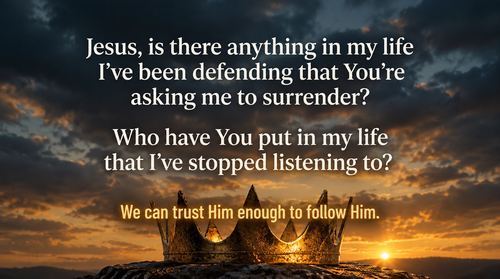
JESUS IS STILL LORD!
Jesus is Lord when His Word comforts me.
Jesus is still Lord when His Word confronts me.
Jesus is Lord when obedience is easy.
Jesus is still Lord when obedience costs me something.
And when I fail, Jesus is still the One who calls me to repentance, meets me with grace, and leads me home.
The gospel isn't an invitation to pretend we're not sinners.
It's the good news that sinners can come home.
So before I call something my conviction, my freedom, or my truth, I want to ask one more time:
Jesus is still Lord when His Word confronts me.
Jesus is Lord when obedience is easy.
Jesus is still Lord when obedience costs me something.
And when I fail, Jesus is still the One who calls me to repentance, meets me with grace, and leads me home.
The gospel isn't an invitation to pretend we're not sinners.
It's the good news that sinners can come home.
So before I call something my conviction, my freedom, or my truth, I want to ask one more time:
Has Jesus already spoken?
And if He has...
I want to follow Him.
Because Jesus is Lord. And by the grace of God, after forty years, I'm still following.

Want to Follow Jesus?
Maybe this stirred something in you. Maybe you have questions about Jesus, baptism, Scripture, or what it means to become His disciple. You don't have to figure it out alone.
We'd love to open the Bible with you and help you take your next step toward Jesus.
Maybe this stirred something in you. Maybe you have questions about Jesus, baptism, Scripture, or what it means to become His disciple. You don't have to figure it out alone.
We'd love to open the Bible with you and help you take your next step toward Jesus.
Posted in Learn
Posted in Jesus Is Lord, Sin, Christian Convictions, Discipleship, Personal Convictions, Christian Living, Repentance
Posted in Jesus Is Lord, Sin, Christian Convictions, Discipleship, Personal Convictions, Christian Living, Repentance
4 Comments
I believe it’s a matter of where our loyalty’s lie.
Absolutely, John. That’s really at the heart of it. Who has the final word in my life?
Thank you for being humble and using personal experience to describe the way to drift away from God. We have to stay alert and recognize the steps leading to sin. Excellent article!
Thank you, Andrea. I really appreciate your encouragement. This was personal for me to share, and I’m grateful the reminder about how easily we can drift connected with you. Staying alert and keeping our hearts open to Jesus is something we all need. ❤️